Bloomberg Businessweek: Apple's Electric Car Fail
Author, Businessweek. Source, Bloomberge Mailshot.
Welcome to Bw Reads, our weekend newsletter that brings an insightful magazine story from Bloomberg Businessweek right to your inbox, in its entirety—and for free. Today we go along with Mark Gurman and Drake Bennett on Apple Inc.’s journey to build a car, cycling through a junkyard’s worth of self-driving designs over the past decade before ultimately giving up. You can read the story online or in full below. If you like what you see, tell your friends! Sign up here.
Around the beginning of 2020, Apple Inc.’s top executives gathered at a former Chrysler testing track in Wittmann, Arizona, to try out the latest incarnation of the car the technology giant had been trying for years to make. The prototype, a white minivan with rounded sides, an all-glass roof, sliding doors and whitewall tires, was designed to comfortably seat four people and inspired by the classic flower-power Volkswagen microbus. The design was referred to within Apple, not always affectionately, as the Bread Loaf. The plan was for the vehicle to hit the market some five years later with a giant TV screen, a powerful audio system and windows that adjusted their own tint. The cabin would have club seating like a private plane, and passengers would be able to turn some of the seats into recliners and footrests.
Most important, the Bread Loaf would have what’s known in the industry as Level 5 autonomy, driving entirely on its own using a revolutionary onboard computer, a new operating system and cloud software developed in-house. There would be no steering wheel and no pedals, just a video-game-style controller or iPhone app for driving at low speed as a backup. Alternately, if the car found itself in a situation that it was unable to navigate, passengers would phone in to an Apple command center and ask to be driven remotely.
In the Arizona desert, Chief Executive Officer Tim Cook, Chief Operating Officer Jeff Williams and senior members of Apple’s design team sat in the prototype as it drove itself around a test track. They loved what they saw. But there was a catch, as the car project’s head, Doug Field, made clear: A lot of work still needed to be done before the autonomous driving system would work in the real world. Field, who’d been hired away from Tesla Inc. to oversee the project, proposed scaling back the self-driving goals to Level 3, which requires a human driver to be ready to take over at a moment’s notice, not watching TV or FaceTiming in a backward-facing seat. But Field’s bosses wanted Level 5.
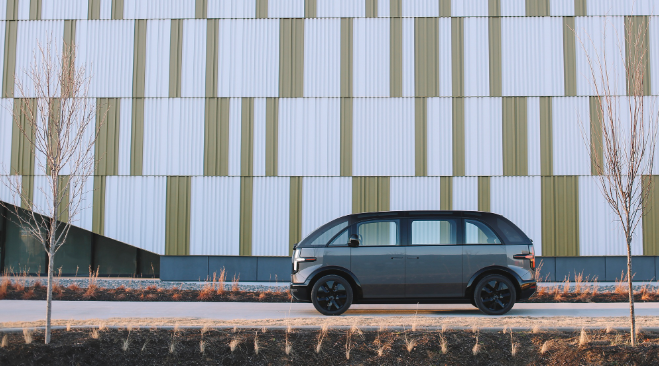
This Canoo electric van gives you a general idea of what the prototype car Apple tested in Arizona looked like. Apple’s was white, with whitewall tires and a sliding door.
The next year, Field left Apple to take over the electric-vehicle and software engineering efforts at Ford Motor Co. Under Field’s successor, Kevin Lynch, who also runs Apple’s smartwatch software group, the car’s design continued to evolve. It had become pod-shaped, with curved glass sides that doubled as gull-wing doors, and the company considered including ramps that would automatically fold out to make heavy cargo easier to load. The front and the back were identical, and the only windows were on the sides, a design choice with potentially dire consequences in the event that a human needed to do any driving. (Front and rear windows were later added.) Some people on the project called it the I-Beam.
The I-Beam never made it into production, nor did any of Apple’s other designs. Now, it seems, they never will. On Feb. 27, Apple told staff it was giving up on developing a car. That decision, while abrupt, was not a surprise. Over the past decade, the company toiled away on at least five different major designs, drove prototype self-driving systems for more than a million miles, hired engineers and designers only to lay them off, and weighed partnerships or acquisitions with Tesla, Mercedes-Benz, BMW, Volkswagen and McLaren Automotive, among others. The car program cost, on average, roughly $1 billion annually (or nearly a fifth of Apple’s research and development budget a decade ago), with outside teams for chips, camera sensors, cloud services and software adding hundreds of millions of dollars more to the yearly spend.
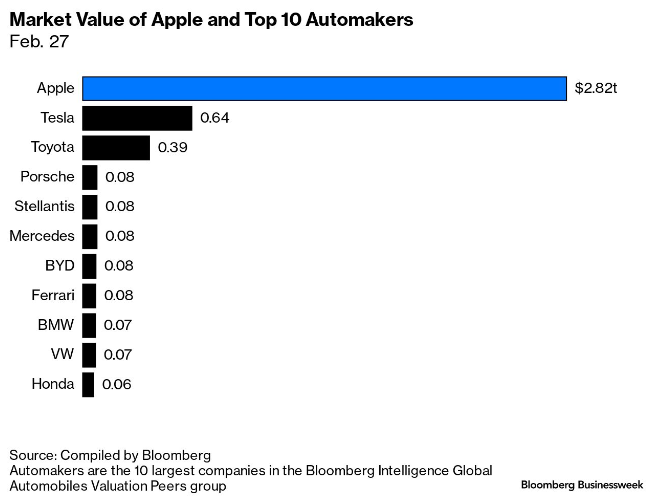
But Apple never got close to realizing its original vision, or any of its subsequent ones. It didn’t get as far as testing a full-scale prototype on public roads. That it didn’t is partly thanks to the enormous technical difficulty of its self-driving goals, as well as the punishing economics of the automaking business. The project was also a failure, at the highest levels of the company, to settle on one thing and do it.
“There are a lot of roads you can take when you have a lot of really smart people and a very big budget,” says Reilly Brennan, a partner at the transportation technology venture fund Trucks VC. “But Apple never had the ability to make a bunch of specific decisions to lead them one way or the other.”
Mark Gurman is hosting a live Q&A about Apple’s failed electric car effort—and what’s next—on Monday, March 11, at 2 pm ET. Send your questions for him to bloombergqa@bloomberg.net.
This story is based on conversations with several people involved in the development of the Apple car over the past decade, nearly all of whom asked to remain unnamed because the work was private. According to a longtime Apple executive who worked on the car, it was widely seen within the company as an ill-conceived product that needed to be put out of its misery. “The big arc was poor leadership that let the program linger, while everyone else in Apple was cringing,” they say. Asked what went wrong with the effort, a senior manager involved in the vehicle’s interior design replied: “What went right?”
What emerges is a portrait of the product development process at Apple today. The $2.6 trillion company has a history of hugely ambitious bets, and a track record of upending long-established businesses. It’s been a while since it did that, however. The iPhone is 17 years old and its sales declined last year, and newer products such as Apple’s watch and AirPods, while profitable, exist mostly in its orbit. The jury’s still out on the Vision Pro. Right now, the company is looking for its next big thing, and does not seem sure how to find it.
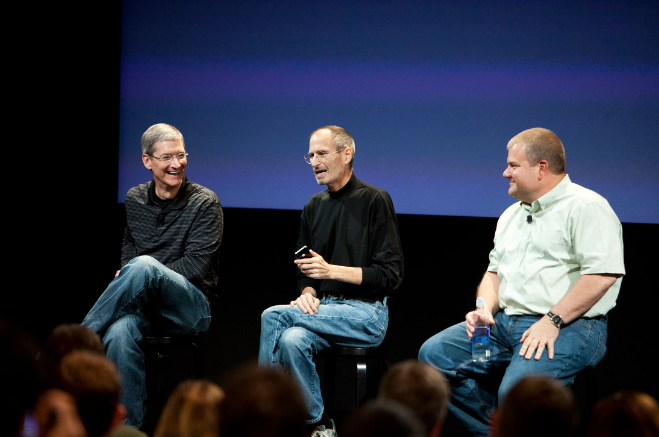
Cook, Jobs and legendary hardware developer Bob Mansfield, later a steward of Apple’s car project, discuss the iPhone 4 during a Q&A at the company’s headquarters in 2010. Photographer: Getty Images